
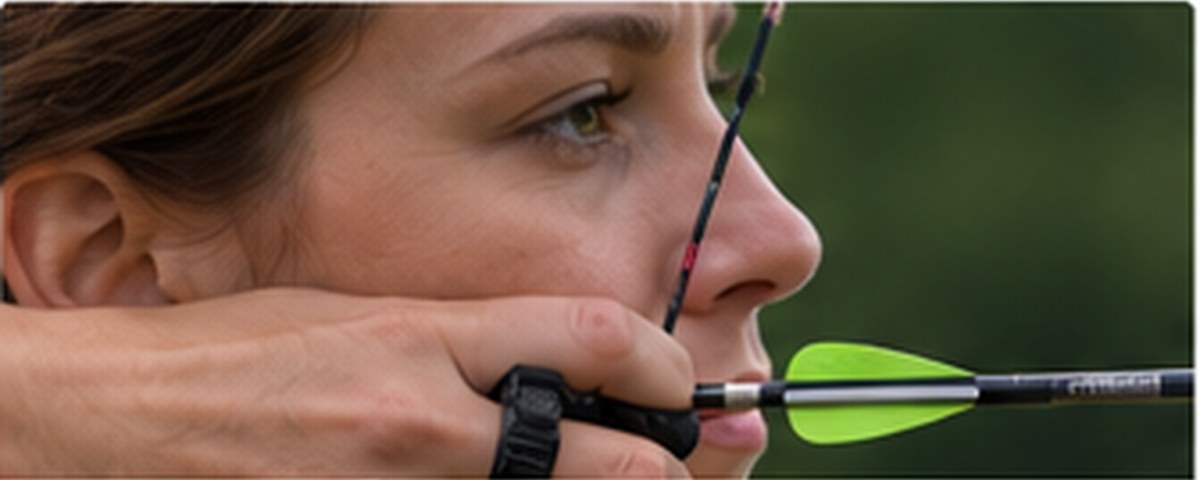
Barebow archers need a way to change the arrow trajectory for different distances while aiming with the arrow point. Two established methods are string walking and face walking. They solve the same problem in different ways.
String walking
The archer keeps a consistent facial anchor but moves the string fingers farther below the arrow nock for shorter distances and closer to the nock for longer distances. The distance between the nock and the finger placement is often called the crawl.
String walking is widely used in competitive barebow because it preserves the anchor while giving precise distance marks. Large crawls can change limb loading and the bow sound, so tiller and nocking-point setup may need to suit barebow use.
Face walking
The fingers remain in a more consistent place on the string while the anchor point moves up or down the face. This changes the relationship between the eye and arrow. It can work well, but the archer must reproduce several facial anchors accurately.
Comparison
| String walking | Face walking | |
|---|---|---|
| Anchor | Usually constant | Changes with distance |
| Finger position | Changes on string | More constant |
| Distance reference | Measured crawl | Facial reference |
| Main challenge | Repeatable tab/string marks | Repeatable multiple anchors |
Building a crawl chart
- Choose a repeatable anchor and tab reference.
- Start at a known distance.
- Move the crawl in small increments until the arrow point can be held at the intended aiming reference.
- Record the crawl on a card or in your training notes.
- Repeat in calm conditions and confirm the mark over several ends.
Competition rules matter
Barebow equipment and tab markings are governed by the rules of the event. Check the current World Archery or Archery GB rules before relying on a particular tab, mark or aiming method in competition.
Further reading and official guidance
Club note: This guide supports coaching rather than replacing it. If a coach, judge or field captain gives an instruction for safety or competition procedure, follow that instruction.