
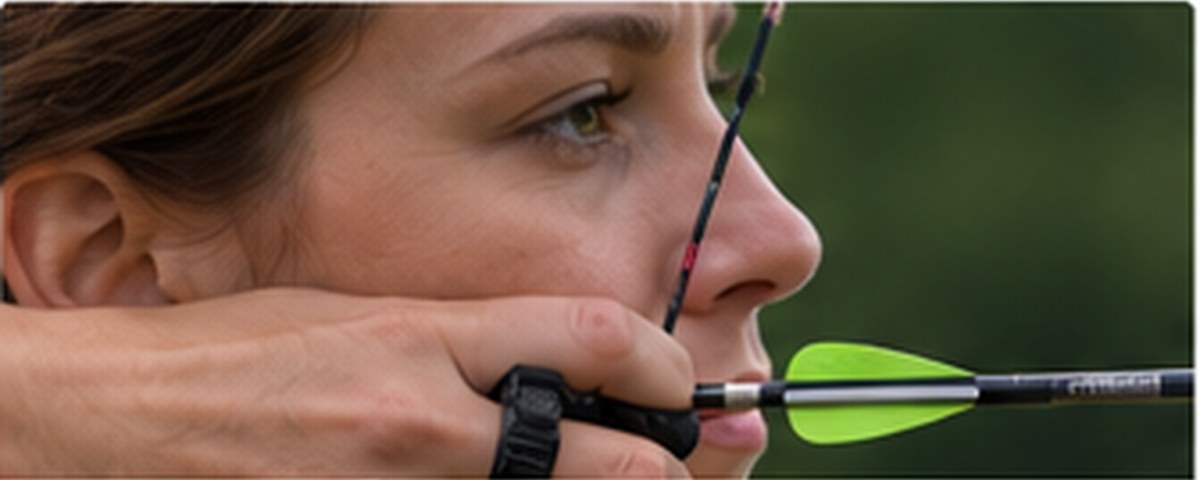
The anchor is the repeatable relationship between the draw hand, string, face and aiming eye at full draw. Small changes at the face can change the direction of the arrow, which is why a dependable anchor is one of the foundations of accuracy.
What makes a good anchor?
A good anchor is repeatable, comfortable and appropriate for your bowstyle. It should use firm anatomical references rather than vague sensations. Common recurve references include the draw hand under the jaw, string contact at the chin and nose, and a repeatable string alignment. Barebow archers often use the corner of the mouth or cheekbone, depending on technique and distance method.
Three reference types
| Reference | What it controls | Typical example |
|---|---|---|
| Hand to face | Draw hand height and position | Index finger beneath jaw or finger at mouth corner |
| String to face | Head and string relationship | String touching chin and nose |
| String picture | Left-right alignment | String aligned with riser or sight aperture |
How to find yours
- Start with a coach and a light enough bow to reach full draw without strain.
- Set a neutral head position before drawing.
- Bring the draw hand to the face instead of moving the head to chase the string.
- Identify two or three references that can be felt clearly.
- Photograph or video the position from the side during a coached session.
- Repeat on a blank boss until the references become automatic.
Signs the anchor is moving
Vertical groups can come from inconsistent hand height or draw length. Left-right variation can come from different string alignment or head rotation. If the sight is tuned but groups drift unpredictably, check the anchor before moving the sight.
Do not force facial contact
Face shape, glasses, jaw structure and bowstyle differ. The aim is not to copy another archer exactly. Build a position that is mechanically stable and repeatable for you.
Further reading and official guidance
Club note: This guide supports coaching rather than replacing it. If a coach, judge or field captain gives an instruction for safety or competition procedure, follow that instruction.